
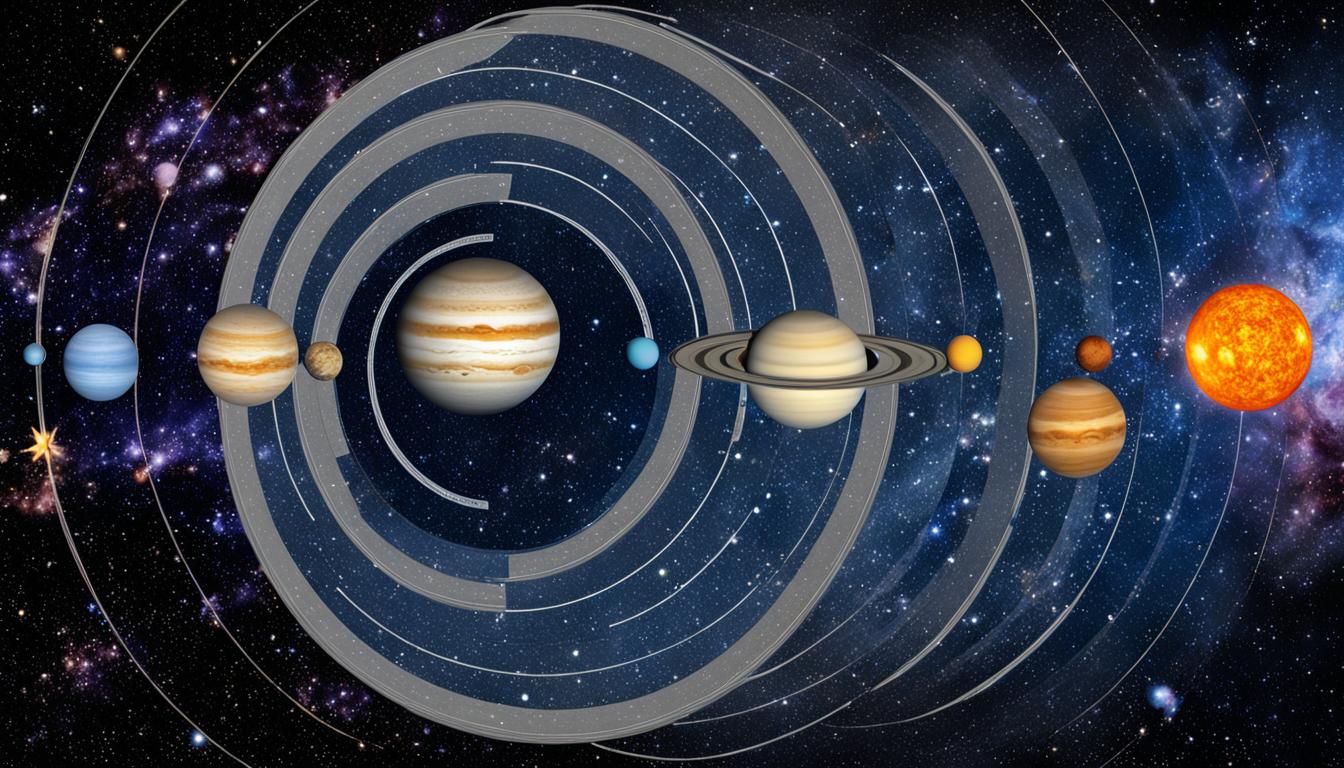
Get ready for an exciting journey through the solar system! We’ll share 10 fun facts that will broaden your knowledge and amaze you. From the sun’s fiery nature to the planets’ unique traits, get set to explore the mysteries of our cosmic neighborhood.
The solar system is vast and full of wonders that have captured the hearts of scientists and stargazers. Let’s dive into 10 fascinating facts that will spark your curiosity and enhance your love for the solar system’s amazing features.
Our Astronomical Neighborhood
The solar system is our cosmic neighborhood, filled with stars and planets orbiting the Sun. This guide will take us through the amazing structure and elements of our solar system. Get ready to explore and learn about the mysteries of our solar system.
Delving into the Cosmic Expanse
At the center of our neighborhood is the Sun, a huge star that keeps the planets and other objects in orbit. As we go deeper, we’ll see the different planets and objects that live in our space.
Unraveling the Mysteries of the Solar System
The solar system is full of secrets, with each planet and moon telling its own story. From Mercury’s heat to Neptune’s ice, exploring the solar system shows us the amazing things that scientists and stargazers find fascinating.
The Scorching Sun: A Blazing Marvel
At the center of our solar system, the sun is a huge ball of hot plasma. It powers everything around it. This giant star is amazing, with its huge size and the vast energy it makes. Its intense heat shows its incredible power and big effect on the planets around it.
The sun’s surface can get as hot as 27 million degrees Fahrenheit. That’s much hotter than anything else in the universe. This heat comes from nuclear reactions in the sun’s core, where hydrogen turns into helium. This process makes a huge amount of energy, which we get as light and warmth.
Even though the sun is huge, it’s just one of many stars in the sky. But it’s the most powerful one, affecting planets far beyond our own. By learning more about the sun, we understand how important it is to our planets and the life on them.
Fun Facts: Uncovering the Solar System’s Secrets
Get ready to be amazed by fun facts about the solar system. We’ll explore the unique features of planets and the surprising discoveries that changed our views. Prepare to be amazed by the incredible secrets of our cosmic neighborhood.
Venus is often called Earth’s twin, but it spins the opposite way. This means the sun rises in the west and sets in the east on Venus. Saturn’s rings are not solid. They are made up of billions of small particles of ice and rock.
Galileo Galilei first saw Saturn’s rings in 1610. This changed how we see the solar system. These facts show how much we still don’t know about our cosmic home.

Recent discoveries have found a ninth planet in our solar system. This mysterious world is still a secret to us. These facts show there’s still much to learn about our universe.
The Planets’ Peculiarities
Our solar system is a remarkable tapestry, woven together by diverse planets. Each has its own unique features and characteristics. From the scorching heat of Venus to the icy landscapes of Neptune, these worlds offer a captivating glimpse into our planetary system’s diversity.
Unveiling the Unique Traits of Celestial Worlds
Venus is known for its dense atmosphere and surface temperatures that can reach 450 degrees Celsius. Its peculiarity lies in its retrograde rotation, spinning in the opposite direction to most other planets. Saturn’s iconic rings, made up of billions of icy particles, show the extraordinary diversity of our solar system.
Exploring the planets reveals a wealth of unique features. Jupiter, the largest planet, is famous for its size and the mesmerizing Great Red Spot, a storm that has lasted for centuries. Mars, the red planet, has rugged terrain, towering volcanoes, and dry riverbeds that hint at a past with flowing water.
The diversity of our solar system’s planets is truly astounding. Each world offers a unique window into the complexities of our celestial environment. From Venus’s Earth-like qualities to Jupiter and Saturn’s icy moons, these peculiarities continue to captivate and inspire us. They fuel our thirst for further exploration and discovery.
The Earth’s Cosmic Companion
The Earth’s moon is a remarkable celestial body that orbits our planet. It is our planet’s only natural satellite. The Moon plays a key role in shaping our environment and influencing natural phenomena. Let’s explore the fascinating facts about the Moon and its importance in our solar system.
The Moon has always fascinated humans. It is the fifth-largest moon in the solar system, about 2,159 miles wide. Its surface shows craters from violent collisions in the past. Dark areas called “maria” were made by ancient lava flows.
The Earth and Moon form a unique pair in our solar system. The Moon’s gravity causes the tides and helps keep our planet’s axis stable. This stability is crucial for a stable climate. The Moon’s phases have been used to track time, and its effects are seen in many living things.
Scientists are still learning about the Moon. Their studies help us understand how our solar system began and how planets and moons formed. This knowledge is vital for understanding the early universe.
Asteroids and Comets: Remnants of the Past
Beyond the planets, our solar system has many smaller bodies like asteroids and comets. These leftovers from the solar system’s start tell us a lot about its early days. Let’s look into these celestial wanderers and their important roles in our changing solar system.
Exploring the Celestial Wanderers
Asteroids are rocky, odd-shaped objects that go around the Sun. They vary from tiny pebbles to huge boulders. They help us understand how our solar system began. Comets are icy bodies that create a beautiful trail of gas and dust as they move near the Sun. Their shows in the sky are a wonder to see.

By looking at asteroids and comets, scientists learn about the solar system’s past. They help us understand the cosmic events that have changed our solar system over billions of years.
The Vastness of the Cosmos
Exploring the solar system shows us the vastness of the cosmos. The universe’s scale is truly amazing. It makes us realize how small we are in the vast space around us.
Grasping the Immensity of Space
Our solar system is tiny compared to the vast cosmos. Stars and galaxies are so far apart, it’s hard to imagine. Proxima Centauri, our closest star, is over 4 light-years away. That means a spacecraft would take years to get there.
Our galaxy, the Milky Way, has billions of stars. It’s just one of trillions in the universe. This shows us how huge the cosmos is.
The vastness of space humbles us. It shows us how small we are in the universe. Yet, it also shows the endless wonders waiting for us to discover. As we explore the solar system, let’s remember the vastness of space. It shows the endless possibilities of the cosmos.
Solar Eclipses: Nature’s Breathtaking Spectacle
Solar eclipses are among the most amazing sights in the sky. They happen when the Moon moves between the Earth and the Sun. This creates a shadow on our planet, showing the Sun’s beautiful corona and stars.
These events are not just beautiful to look at. They also show the science behind them. The Earth, Moon, and Sun line up perfectly to make this happen. This creates a path of darkness on Earth, letting us see how our solar system works.
People have been amazed by solar eclipses for a long time. They inspire awe and make us want to learn more about space. Whether you’re an expert or new to astronomy, seeing a solar eclipse is unforgettable. It shows the beauty and complexity of our solar system.
The Ever-Expanding Frontiers
Our understanding of the solar system is growing, making space exploration’s frontiers bigger. Scientists and space agencies worldwide are working hard. They aim to push our cosmic knowledge to new limits.
The solar system’s expanding boundaries show us the vast, unexplored areas beyond our planets. We’re diving into the mysteries of distant worlds and the unknown. This drive is leading to new and thrilling discoveries.
Exploring the unknown is opening up new secrets for us. Every new mission and tech advance brings us closer to understanding the solar system and the cosmos. This excites scientists and the public alike.
Space Exploration: Humanity’s Cosmic Journey
Humans have always been drawn to the stars, driving our quest for space exploration. From the start of rocketry to today’s advanced missions, space travel shows our endless drive to explore the universe. It’s a story of human spirit, pushing us to learn about our solar system and what lies beyond.
The story of space exploration is filled with scientific discoveries and technological leaps. It began with the launch of Sputnik, the first satellite, and reached new heights with the Apollo missions to the Moon. Each step has deepened our knowledge of space and our role in it.
Looking ahead, the future of space exploration is vast. With reusable rockets, a human base on the Moon, and plans for Mars, our journey continues. The possibilities for new discoveries and innovations are endless, limited only by our dreams.