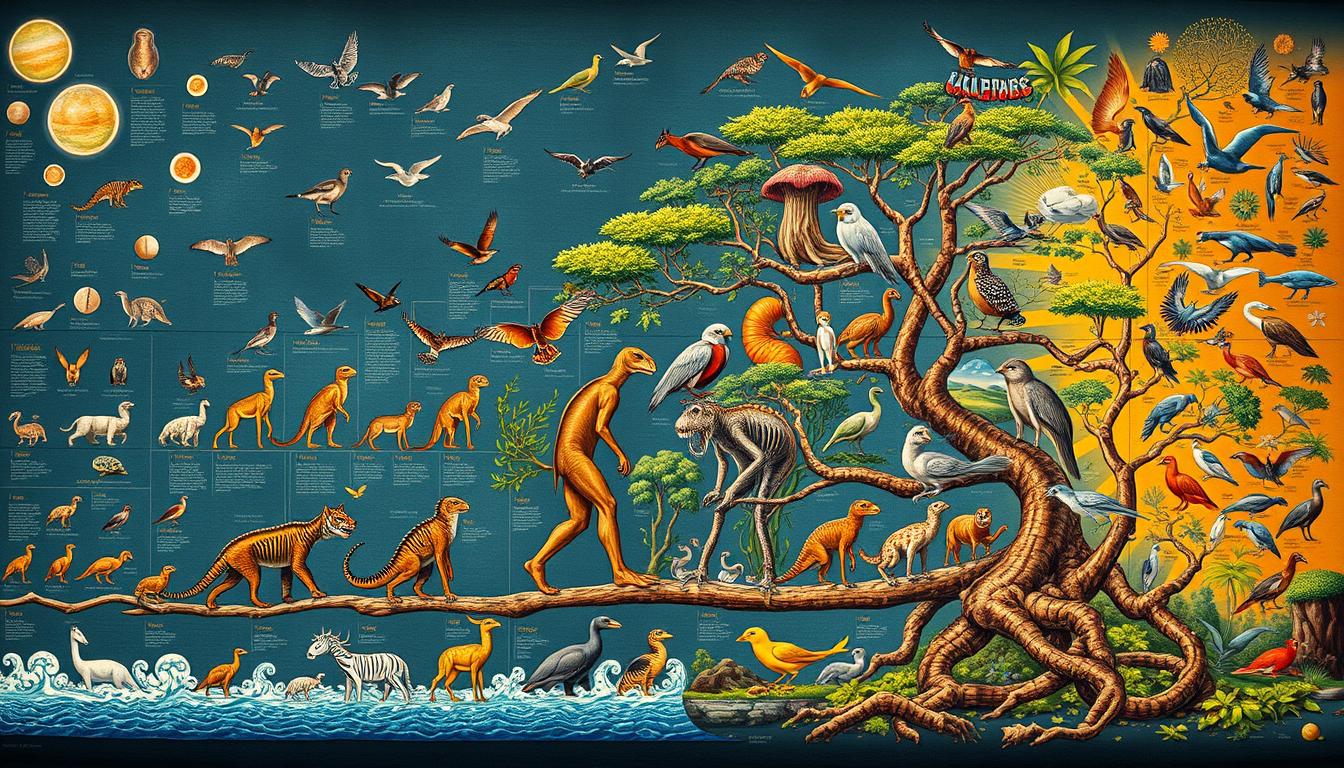
The journey of life on Earth is full of adaptation and change. From simple cells to the variety of species today, evolution is key. It shows how humans and animals have changed over millions of years.
Evolutionary biology studies how life changes over time. It looks at natural selection and genetic changes. This helps us understand how species adapt and diversify.
The evolution of humans is fascinating. Genetic changes and environmental pressures shaped our traits. This allowed us to live in different places and adapt to new situations.
Animals have also evolved in amazing ways. From simple cells to complex creatures, each species has adapted. They respond to their environments in unique ways.
Exploring evolutionary science helps us see how all life is connected. It shows the ongoing change on our planet. By understanding evolution, we can learn from the past and prepare for the future.
Understanding Evolutionary Science: A Primer
Evolutionary science is a key part of modern biology. It helps us understand the variety and growth of life over time. Charles Darwin’s work, especially “On the Origin of Species,” was a big step forward. It introduced the idea of natural selection.
Evolutionary theory says all living things came from simpler forms through gradual changes. These changes are driven by variation, inheritance, and selection. This method has helped us learn about life, from where species come from to how they adapt to different places.
“Evolution is a light which illuminates all facts, a trajectory which all lines of thought must follow.”
– Jean Rostand, French biologist and philosopher
Evolutionary science affects more than just biology. It also shapes anthropology, paleontology, and medicine. By studying species’ evolutionary history, scientists learn about the creation of new life and how it survives.
Exploring evolutionary science reveals a wealth of knowledge. It satisfies our curiosity about the world and helps us understand complex systems in nature.
The Origins of Life on Earth
The origins of life on Earth have always fascinated scientists and philosophers. From the primordial soup to the first single-celled organisms, life’s evolution is complex and intriguing. The RNA world hypothesis suggests RNA was the first self-replicating molecule, leading to more complex life.
The idea of a primordial soup filled with organic compounds is now widely accepted. These single-celled organisms, or prokaryotes, were the first life on Earth. They set the stage for the wide variety of life we see today.

“The origin of life is one of the greatest unsolved mysteries in science. The search for the first self-replicating molecules and the emergence of cellular life continues to captivate researchers around the world.”
Though the exact start of life is still debated, scientists have made big progress. They’ve uncovered the key events leading to the earliest lifeforms. From the primordial soup to the RNA world hypothesis, the origins of life on Earth are a constant source of wonder and inspiration.
Natural Selection: The Mechanism of Evolution
At the heart of evolutionary science lies the concept of natural selection. It’s the driving force behind the survival of the fittest. This fundamental mechanism explains how genetic variation within a population, coupled with environmental pressures, leads to adaptation and evolution of species over time.
When organisms have certain genetic traits that help them adapt to their surroundings, they are more likely to survive and reproduce. This process of adaptation ensures that favorable traits are passed on to future generations. Meanwhile, less advantageous characteristics gradually diminish within the population. The interplay between genetic variation and environmental factors is key to understanding how evolution unfolds.
“Nothing in biology makes sense except in the light of evolution.” – Theodosius Dobzhansky
Through the process of inheritance, these advantageous traits are inherited by offspring. This strengthens the population’s ability to adapt and thrive. This cyclical pattern of natural selection, adaptation, and inheritance is the foundation upon which the evolution of all living organisms is built.
By recognizing the significance of natural selection, we can gain a deeper appreciation for the remarkable diversity of life on Earth. We also understand the ongoing process of evolution that continues to shape the world around us.
The Evolution of Humans: A Unique Journey
Homo sapiens, the species we call humans, have a unique evolutionary path. Our ancestors evolved in ways that set us apart from other hominids. Key adaptations include bipedalism and advanced cognitive abilities.
Our ancestors moved from walking on all fours to walking on two legs. This change allowed them to use their hands for making tools and solving complex problems. The growth of our brain size also played a big role in our cognitive development.
“The evolution of the human brain is one of the most fascinating and complex stories in the history of life on Earth.”
As we evolved, our thinking, reasoning, and communication skills improved. These abilities helped us succeed in many environments. We adapted to cold tundras and hot deserts, thriving in different ecosystems.
Today, we see the results of human evolution in our achievements. We’ve created advanced technologies and explored space. The journey of Homo sapiens shows the incredible adaptability of life on Earth.

The Influence of Genetics on Evolution
Genetics are key in evolution, guiding how living things change and adapt. DNA, the genetic blueprint, is at the center of this. Changes in DNA can introduce new traits, some good, some bad for survival.
Epigenetics, the study of gene expression changes, also affects evolution. These changes can lead to different physical traits and adaptations in a population.
Genetic drift, random gene changes, is another vital factor. It can cause some traits to disappear or become common, helping species diversify over time.
“Genetics is the study of how information is transferred from one generation to the next and how that information shapes the individual.” – Theodosius Dobzhansky, evolutionary biologist
Scientists study DNA, gene expression, epigenetics, and genetic drift to understand evolution. This knowledge helps solve big problems like saving endangered species and finding treatments for genetic diseases.
The Evolution of Animals: From Simple to Complex
The journey of life on Earth is a fascinating tale of evolution. It started with simple single-celled organisms and evolved into the diverse multicellular creatures we see today. This path has led to a wide range of invertebrates and vertebrates, each with unique adaptations.
The origins of animal life began with the emergence of multicellular organisms. This was a key event that paved the way for the amazing diversity we see today. Through speciation, these early life forms evolved into different species, each with its own traits and roles in ecosystems.
“Evolution is a process of continuous change from the simple to the more complex, from the general to the specialized, from the homogeneous to the heterogeneous.” – Herbert Spencer
As evolution continued, invertebrates like sponges, corals, and insects emerged. They showed incredible diversity in body plans and adaptations. These organisms were crucial in shaping early ecosystems, making way for the rise of vertebrates – the complex animals we know today, including fish, amphibians, reptiles, birds, and mammals.
The evolution of animals is a captivating story that continues to unfold. It shows us the intricate mechanisms behind the incredible variety of life in our world. By understanding this journey, we appreciate the resilience and adaptability of living organisms and the complexity that has emerged through evolution.
Cooperative Behavior in Evolution
In the world of evolutionary science, cooperative behavior is a big topic. It includes symbiotic relationships and the social lives of social insects. Cooperation has been key in evolution.
Mutualism is a great example. It’s when two species help each other out. This is seen in bees pollinating flowers and bacteria helping plants grow.
“The evolution of cooperation is a central problem in biology, as cooperation appears to be at odds with the fundamental principle of natural selection, which favors the survival of the fittest.”
The social lives of social insects like ants and bees are also interesting. They show how working together can help a group survive, not just one individual.
Exploring cooperative behavior in evolution gives us new views on the natural world. It shows how diversity comes to be.
Extinction Events: A Part of Evolution
Evolutionary science is a field that shows how species and their environment interact. Extinction events have greatly influenced life on Earth. These events, like the mass extinctions that killed the dinosaurs, have led to new species through adaptive radiation.
The Cretaceous-Paleogene extinction, or K-T extinction, happened about 66 million years ago. It was caused by a huge asteroid impact. This event killed the dinosaurs and allowed mammals and other modern animals to evolve. It changed evolution’s path, making way for our species.
“Extinction is the rule. Survival is the exception.”
– Carl Sagan
But extinction isn’t just a thing of the past. Climate change from human actions threatens today’s species. As our planet changes, many species struggle to adapt. This makes understanding past mass extinctions key for facing today’s challenges.
By looking at the past, we learn about life’s resilience. Evolution’s story is one of constant change. Extinction events and adaptive radiation have shaped life’s diversity. As we study nature, we must think about our impact and protect life’s balance.

Evolution in Modern Times: A Continuing Process
Evolution is not just a thing of the past. It’s still happening and shaping our world. We’ve seen fast changes in life on Earth, showing how dynamic it is.
Antibiotic resistance in bacteria is a big issue today. We’ve used antibiotics a lot, and some bacteria have learned to fight them. This makes it hard to treat diseases. Pesticides have also led to resistant insects, making it tough to control pests.
Industrial melanism is another cool example. Moths have turned darker in polluted areas. This helps them survive and have more babies, changing their look fast.
These examples show evolution is always adapting to new situations. Rapid evolution happens because of changes we make, showing how connected all life is.
“Evolution is the process by which living organisms change over time through the inheritance of genetic variations.”
Learning about evolution helps us understand life’s strength and ability to adapt. It shows us how to face future challenges, like fighting diseases and saving species.
Evolutionary Science and Paleontology
Evolutionary science and paleontology are closely linked. Each field helps the other grow. Fossils, the remains of ancient life, let us see how species evolved. By studying the physical structures of different organisms, we learn about their evolutionary ties.
Fossils show us extinct species and their links to today’s life. By looking at fossils and comparing different species’ anatomy, scientists build phylogenetic trees. These trees show how various life forms are connected.
New tools in molecular biology and the molecular clock have changed how we see evolution. By studying genes, scientists figure out when species split. This adds to what we know from fossils and comparative anatomy.

By combining fossils, anatomy, and molecular biology, scientists have a deeper view of life’s history. As new fossils are found and technology improves, this field keeps growing. The connection between evolutionary science and paleontology is always changing.
The Role of Environment in Evolution
Our study of evolution shows how much the environment affects life on Earth. It shapes the variety of species we see today. This includes the creation of ecological niches and the amazing process of adaptive radiation.
Organisms adapt to their surroundings, finding unique ecological niches to thrive. This leads to diverse life forms as species evolve to fill these niches. The Galapagos finches are a great example of this.
The environment also drives convergent evolution. This is when different species develop similar traits due to environmental pressures. For example, sharks and dolphins have streamlined bodies, while hedgehogs and porcupines have spines for defense.
Lastly, biogeography is key to understanding how the environment influences evolution. The isolation of species in unique habitats, like islands, leads to distinct evolutionary paths. This results in the incredible diversity we observe today.
Future Outlook: Evolutionary Science Advancements
The world of evolutionary science is on the brink of big changes. New technologies and research are leading the way. Genomics, which studies an organism’s genes, has changed how we see evolution. It gives us deep insights into how species come to be and adapt.
CRISPR gene editing has given scientists a new tool. They can now change genes with precision. This opens up new areas in evolutionary engineering and synthetic biology.
Artificial selection, or breeding for certain traits, has been used by humans for a long time. But with genomics, we can do it better. Synthetic biology lets us create new life forms. This is a big step in evolutionary science.
These advances could lead to big wins in medicine and saving the environment. By studying how species evolve, we get closer to understanding life itself. The future of evolutionary science is full of discovery. It will change how we see the world and our place in it.