
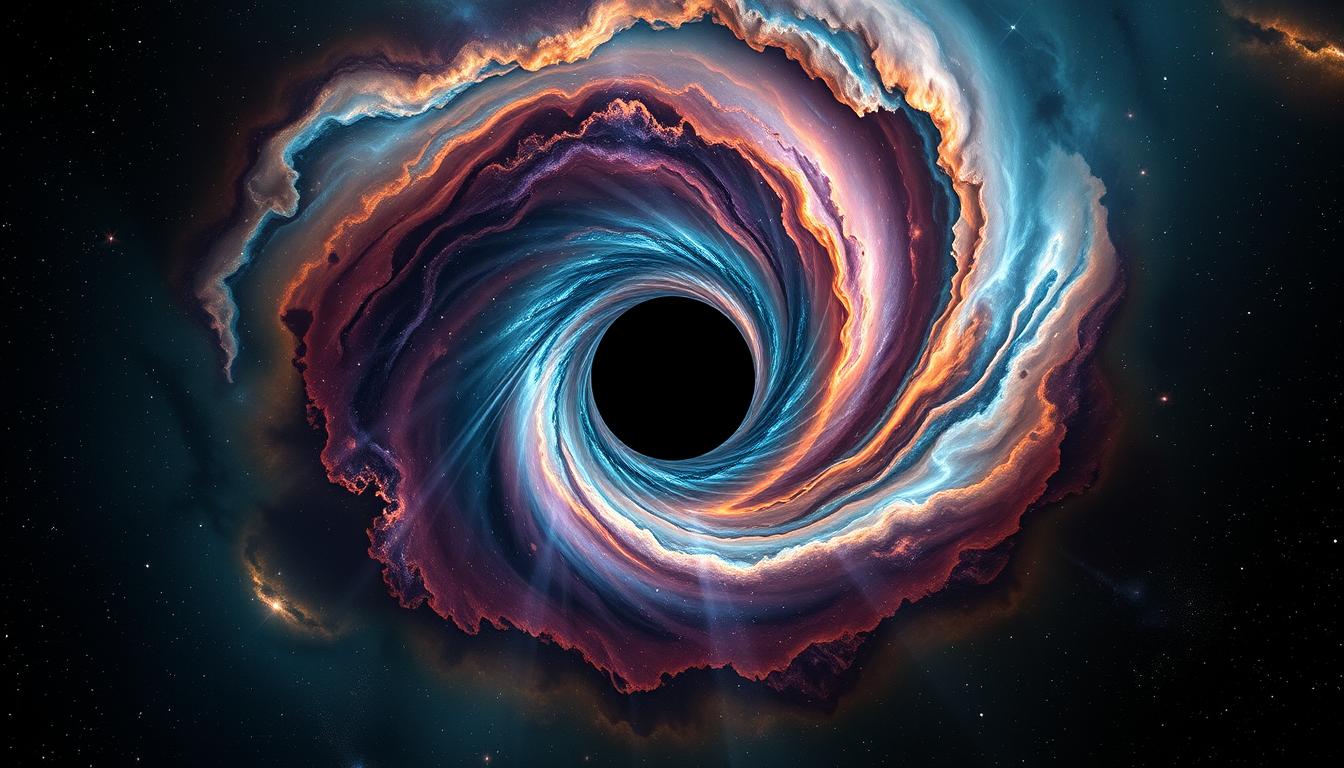
Explore the world of black holes, where physics and space-time are tested. These cosmic wonders were once just theories but now excite scientists. Learn about their mysterious nature, properties, and how they change our view of the universe.
Black holes are known for their strong gravity and strange concepts like singularity and event horizons. They fascinate scientists and the public. Let’s uncover the secrets of these celestial marvels and their role in the universe.
What Are Black Holes?
Black holes are mysterious and fascinating objects in space. They form when a huge star collapses, creating a gravity well so strong that light can’t escape. Inside a black hole, matter is squeezed into a single point, called a singularity. Here, the usual laws of physics don’t apply.
At the center of a black hole is an event horizon. This is a point where nothing, not even light, can come back. It’s the point of no return, where the black hole’s gravitational pull warps space and time. Anything too close to this point is pulled in and lost forever.
Black holes show the incredible power of collapsed stars. When a massive star exhausts its fuel, it collapses under its own gravity. This creates a dense object with strong light absorption abilities. The star’s gravity overcomes the outward pressure that kept it stable.
Types of Black Holes
Black holes vary greatly in size. They range from the smallest stellar-mass black holes to the huge supermassive black holes at galaxy centers. Stellar-mass black holes form when massive stars collapse. They create a dense area that pulls in everything, even light.
Supermassive black holes are at the heart of most galaxies, including ours. They are much bigger than our Sun, with some being millions or billions of times larger. Their strong gravity shapes their galaxies.
“Black holes are the most extreme objects in the universe, and understanding their formation and evolution is crucial to unraveling the mysteries of the cosmos.”
There might also be intermediate black holes, between stellar-mass and supermassive ones. Their existence is still debated. But, some think they could help us understand black hole growth.

Studying black holes is fascinating for scientists and the public. As we learn more, we might find even more types of black holes. This could help us understand the universe and our place in it better.
How Black Holes Are Detected
Discovering black holes is a complex task. Astronomers use many methods, like watching gravitational waves and X-ray emissions. They also use strong radio telescopes. These tools help us learn about black holes.
Gravitational waves have changed how we see black holes. When black holes or neutron stars crash, they send out gravitational waves. These waves are caught by places like LIGO. This lets scientists study the crash.
“The detection of gravitational waves has opened a new window on the universe, allowing us to observe phenomena that were previously invisible to traditional telescopes.”
X-ray astronomy is also key in finding black holes. Black holes pull in matter, which makes X-rays. Space-based telescopes can spot these X-rays. This helps find black holes in space.
Radio telescopes, like the Event Horizon Telescope, have made big discoveries. They can show us what’s near black holes. By looking at these radio waves, scientists learn more about black holes.
Together, these methods have changed how we see black holes. They help us understand these mysterious objects better.
The Role of Black Holes in the Universe
Black holes are mysterious objects that shape our universe. They play a key role in galaxy formation and cosmic evolution. These gravitational giants have a big impact on the cosmos.
Black holes help create galaxies. They pull matter and gas into their strong fields. This creates discs that can start new stars, helping galaxies grow.
Black holes also affect the universe’s evolution. Quasars, very bright galaxy centers, are powered by supermassive black holes. These black holes shape galaxies and drive changes in the universe.
“Black holes are the most extreme objects in the universe, and we are only beginning to understand their full impact on the cosmos.”
Scientists are learning more about black holes. Their discoveries change how we see galaxy formation, cosmic evolution, and quasars. The study of black holes is fascinating and continues to grow.

The Science of Singularity
At the heart of a black hole lies a mysterious concept called singularity. This area has infinite density and warps space-time in ways we can’t fully understand. Scientists struggle to grasp this phenomenon because it tests the limits of our current theories.
The idea of singularity is linked to black holes. These areas have such strong gravity that nothing, not even light, can escape. As matter falls into a black hole, it gets compressed to an infinite point, creating a singularity at the center.
This singularity is a true puzzle, challenging our understanding of physics. The laws of general relativity work well for most of the universe but fail at the heart of a black hole. Scientists aim to create a theory of quantum gravity to bridge this gap.
The search for a unified theory to explain singularity is a major challenge in physics. Exploring black holes and the limits of our knowledge highlights the importance of this quest. Unraveling singularity’s secrets could reveal new insights into the universe and space-time itself.
Hawking Radiation: A Groundbreaking Concept
Stephen Hawking’s idea of black hole evaporation changed how we see black holes. He showed that black holes can release particles, known as Hawking radiation. This idea came from quantum mechanics.
Hawking said black holes aren’t completely black. They slowly lose mass through radiation. This idea changed our view of black holes. It showed that even light can escape, challenging old beliefs.
“Black holes ain’t as black as they are painted. They are not the eternal prisons they were once thought. Things can get out of a black hole both on the outside and possibly to another universe.”

Hawking’s work on black hole radiation changed our view of the universe. He showed that black holes can release particles, challenging our old views. Scientists are still studying the black hole evaporation process and its role in the universe.
Exploring the Event Horizon
As you get closer to a black hole, you’ll hit its key feature – the event horizon. This is where nothing, not even light, can escape the black hole’s pull. If you get too close, you’ll see light bending, as space-time warps around the black hole.
But the real show starts when you cross the event horizon. Once you’re past it, gravity pulls you apart, stretching you like spaghetti. This shows how incredibly powerful black holes are, pushing the limits of what we think is possible.
The event horizon is a fascinating and mysterious part of black holes. It offers a glimpse into the unknown. As we learn more about black holes, the event horizon might reveal secrets about our universe and its forces.
Black Holes and Time Dilation
Black holes are more than just massive gravitational forces. They also warp time in incredible ways. This connection to time warping and relativity is truly fascinating.
As objects near a black hole, time slows down dramatically. This effect, predicted by Einstein, shows the incredible power of black holes. Near the event horizon, space and time get so distorted that time stretches almost beyond belief.
“Near a black hole, the slowing of time is extreme. From the viewpoint of an observer outside the black hole, time stops at the event horizon.”
This time warping has big implications for our understanding of the universe. It also opens up new ways to explore black holes. Scientists are working hard to learn more about this relationship, expanding our knowledge.

Exploring black holes teaches us about the strange and counterintuitive nature of time. By studying time warping, we learn more about our universe and the huge impact of black holes.
Future Research on Black Holes
Studying black holes is a growing field. Researchers are always finding new ways to learn about them. The Event Horizon Telescope is a global network of radio telescopes. It aims to capture the first-ever image of a black hole’s event horizon.
Space-based observatories, like LIGO, are also key. They help detect gravitational waves from black hole collisions. These waves give us valuable insights into black holes and their role in the universe.
“The future of black hole research is brimming with possibility, as we continue to push the boundaries of our technological capabilities and our understanding of the universe.”
Scientists are also looking at black holes as natural labs. They test our theories, including singularity and Hawking radiation. By solving black hole mysteries, we might understand spacetime and the universe’s origins.
The future of black hole research is full of promise. We’re improving our tech and understanding of the universe. Projects like the Event Horizon Telescope and studying gravitational waves will lead to big discoveries.
Cultural Impact of Black Holes
Black holes have fascinated people, sparking countless works in science fiction, film, and art. Iconic scenes in “Interstellar” and mind-bending stories in “Cosmos” show their impact. These cosmic wonders have deeply influenced popular culture.
Writers, directors, and artists see black holes as a way to explore the unknown. They delve into the limits of human knowledge, time, and our existence. This has made black holes a symbol of the mysteries of the universe.
Black holes have also been key in science education. The idea of a singularity, where physics ends, excites many students. It encourages them to study astrophysics and cosmology.
Stunning images and simulations of black holes engage the public. They help people appreciate the universe’s wonders. This has made black holes a powerful tool for science outreach.
As we learn more about black holes, their cultural impact will grow. The scientific community’s work will inspire new artists, writers, and thinkers. They will explore the unknown, driven by curiosity and a desire to understand the cosmos.