
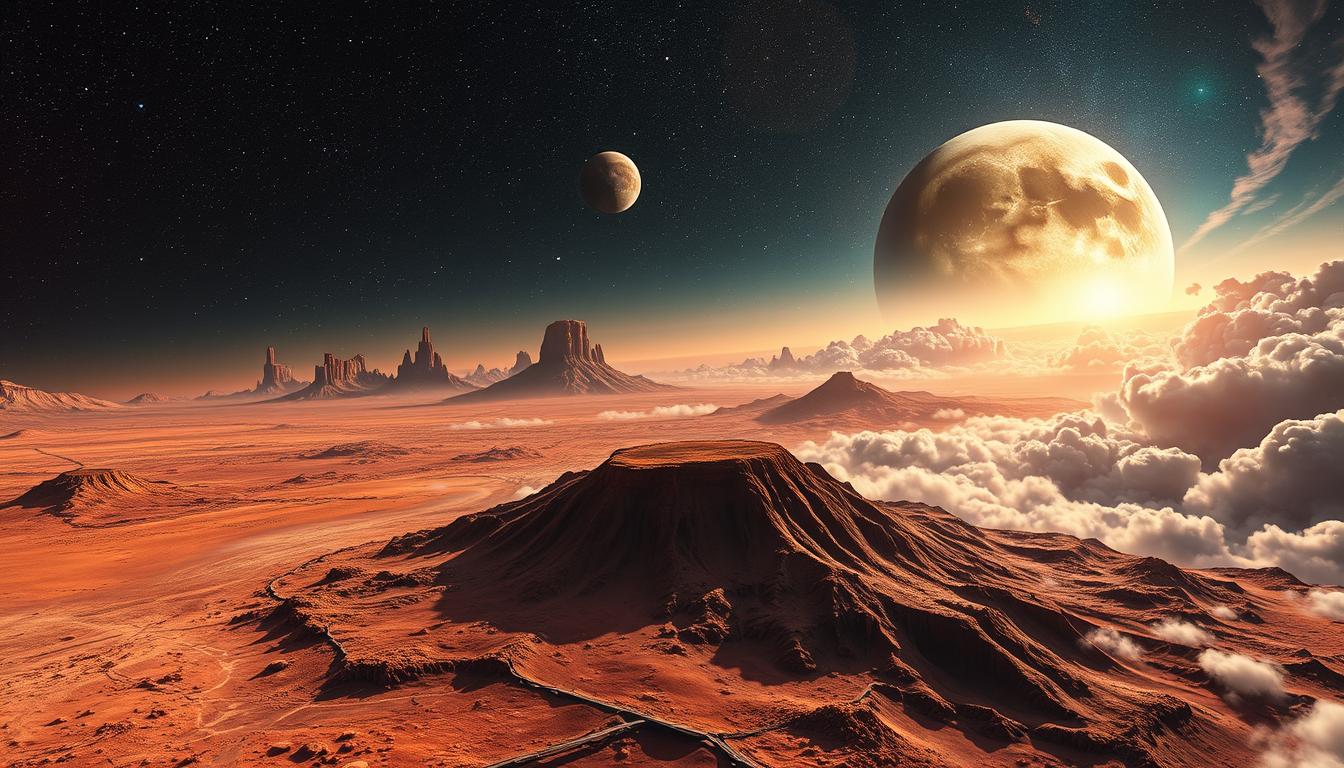
For thousands of years, humans have been fascinated by the stars. From ancient times to today, the planets have captured our hearts. We’re going to explore Mars, Venus, and other planets, revealing their secrets.
Planetary science is a field that studies the planets around our sun. It looks at how they formed, what they’re made of, and how they’ve changed over time. Each planet has its own story, from Mars’ rough terrain to Jupiter’s gas giants. Scientists and space agencies are working hard to learn more about these mysteries.
Let’s start an exciting journey through the solar system. We’ll discover the wonders of our cosmic neighbors and the latest discoveries in planetary science. Get ready to be amazed and learn as we uncover the secrets of the planets.
Introduction to Planetary Science
Planetary science is a field that mixes astronomy, planetary geology, and astrophysics. It studies the many bodies in our solar system and beyond. This field explores how planets, moons, asteroids, and more form and change.
At its heart, planetary science is about exploring our cosmic neighborhood. Each planet, like Mars with its red color or Jupiter with its gas, has its own story. Scientists use new tech and teamwork to learn more about these distant worlds.
“Planetary science is not just about learning the facts, but about understanding the processes that shape the planets and moons we see in our solar system.” – Dr. Jane Doe, Professor of Planetary Geology
The history of planetary science is filled with big discoveries. From Galileo Galilei’s early work to today’s space missions, each step has shown us more about the universe. These discoveries have greatly changed how we see the cosmos.
As we learn more about planetary science, we grow to love the variety and complexity of space. This field helps us understand our solar system better. It also prepares us for more space research and exploration, showing us our place in the vast universe.
Mars: The Red Planet
Mars, the captivating “Red Planet,” has long fascinated humanity. Its thin Martian atmosphere and striking surface features offer a unique glimpse into our solar system’s mysteries. Recent missions like NASA’s Curiosity rover and Perseverance mission have uncovered clues about water on Mars and life’s possibility.
Mars’ polar ice caps are a key interest. They are made of water ice and frozen carbon dioxide. These ice caps tell us about Mars’ climate history and water resources for future humans. The Curiosity rover found ancient lake beds, showing Mars was once more welcoming.

The Perseverance mission has deepened our Mars knowledge. This rover has advanced tools for studying Mars’ geology and climate. It also searches for ancient life signs. Its ability to collect samples for Earth return marks a major step in Mars exploration.
“Mars is a lifeless, barren, and inhospitable world – at least on the surface. But beneath the surface, it may harbor life.”
As we learn more about Mars, these missions’ findings will shape our solar system understanding. Exploring Mars is a captivating journey. It promises to reveal more about our celestial neighbors’ origins and evolution.
Venus: Earth’s Twin
Venus is often called Earth’s twin because of their similar size and mass. But, Venus is very different in terms of being habitable. Its surface is extremely hot, reaching 450°C (over 800°F), hot enough to melt lead.
This heat is due to a runaway greenhouse effect. Venus’s thick atmosphere, mostly carbon dioxide, traps the sun’s heat. This makes Venus a planetary inferno.
The atmosphere on Venus is over 90 times denser than Earth’s. This creates a surface pressure like being nearly a kilometer deep in the ocean. This dense atmosphere traps the sun’s heat, causing Venus to get hotter and hotter.
Learning about the greenhouse effect and planetary evolution on Venus helps us understand life on Earth. It shows how delicate our planet’s balance is.
“Venus is the most inhospitable place in the solar system – a world of crushing atmospheric pressure, scorching heat, and a toxic, corrosive atmosphere.”
Studying Venus’s atmosphere and surface temperature is key to understanding climate change. Venus warns us about the dangers of unchecked greenhouse gas emissions. It shows how fragile a planet’s ecosystem can be.
The Gas Giants: Jupiter and Saturn
Jupiter and Saturn are the largest planets in our solar system. They have amazing features that capture our attention. Jupiter’s most famous spot is the Great Red Spot, a huge storm bigger than Earth. This storm has been going on for centuries.
This giant planet also has a complex atmosphere and many Jovian moons. Saturn, on the other hand, is known for its stunning ring system. It’s made of ice and rock particles. The Cassini mission has given us a closer look at Saturn, showing us its dynamic atmosphere and moons.
“The Cassini mission to Saturn has been one of the greatest scientific adventures of our time, revealing the wonders of this magnificent planet and its captivating system of rings and moons.”
Exploring the gas giants is a journey of discovery. We learn about their formation, evolution, and how they change. This journey fascinates scientists and the public.

The Ice Giants: Uranus and Neptune
Uranus and Neptune are the ice giants of our solar system. They are still a mystery to us, unlike the gas giants. These planets have unique traits that keep scientists interested.
Uranus is known as the “sideways planet” because it tilts at 97.8 degrees. This tilt, caused by a massive impact, affects its seasons and weather. Its atmosphere, rich in methane, makes it look blue-green.
Neptune’s atmosphere is full of storms, including the Great Dark Spot seen by Voyager 2. Like Uranus, its methane-rich atmosphere gives it a deep blue color. Neptune’s moon, Triton, is also fascinating, with its geysers and icy surface.
The ice giants are key to understanding our solar system. Their tilted axes and methane-rich atmospheres tell us about the system’s formation. Exploring these planets, like Voyager 2 did, will reveal more about them.
Exoplanets: Worlds Beyond Our Solar System
The discovery of exoplanets has changed how we see the universe. Astronomers use methods like transit photometry and radial velocity to find these planets. Transit photometry spots planets by the star’s brightness drop when a planet passes in front. Radial velocity tracks the star’s wobble caused by a planet’s gravity.
Found exoplanets vary from huge hot Jupiters to planets in habitable zones. The discovery of super-Earths is especially thrilling. These planets are bigger than Earth but smaller than Neptune. They might be rocky and could support life.
“The diversity of exoplanets we’ve found so far has been truly astonishing, from these strange hot Jupiters to potentially habitable super-Earths. It’s clear that nature has a remarkable ability to create a wide range of planetary systems, and we’ve only begun to scratch the surface.”
As we get better at finding exoplanets, we’ll learn more about planets in the universe. This will help us understand where life might exist. It will also change how we see our place in the universe and our search for alien life.

The Role of Telescopes in Planetary Science
Telescopes are key in planetary science, both on Earth and in space. They include ground-based observatories and space-based tools like the Hubble and James Webb Space Telescopes. These tools help scientists study planets and moons in great detail.
Telescopes are important for spectroscopy, which analyzes light from celestial bodies. This method gives insights into a planet’s composition, atmosphere, and life potential. Ground-based telescopes use adaptive optics to get clearer images, overcoming Earth’s atmosphere distortion.
Telescopes also help find and study exoplanets – planets around other stars. By watching a star’s brightness or its motion, scientists can spot planets. They can even learn about a planet’s size, mass, and atmosphere.
“Telescopes are the eyes of the scientific community, allowing us to peer deeper into the cosmos and unravel the mysteries of our solar system and beyond.”
As we learn more about planetary science, telescopes will be even more vital. They help us understand our planets and search for life elsewhere. These instruments are central to our cosmic exploration.
Planetary Geology: Studying Planetary Surfaces
Planetary geology is a field that explores the surfaces of planets and moons. It looks at the composition, structure, and processes that shape them. From the impact craters on the Moon to the volcanoes on Mars, these features tell us a lot about our solar system.
Scientists use remote sensing to study these surfaces without visiting them. They create detailed maps and high-resolution images. These show the details of plate tectonics and other geological activities. They help us understand the history of these worlds.
“The study of planetary geology is like piecing together a cosmic puzzle, each feature a clue to the past and future of these distant worlds.”
By studying impact craters, scientists learn about the bombardment history of planets. Volcanic features tell us about a planet’s internal heat and tectonic processes. This helps us appreciate the forces that have shaped our planet.
As planetary science grows, we’ll learn more about our solar system’s surfaces. Exploring these wonders helps us understand our own planet and the universe. It shows the diversity and complexity of our solar system.
The Evolution of Our Solar System
Learning about how our solar system formed is key in planetary science. Scientists think our solar system came from a protoplanetary disk. This was a spinning cloud of gas and dust around the young Sun. Over time, this solar nebula collapsed, starting the planetary formation that created our planets.
The migration theory is another important idea. It says planets didn’t always be in their current spots. Instead, they moved a lot over billions of years. This theory explains how planets and their moons move and why we have asteroids and comets.
As scientists learn more about planetary formation and our solar system’s evolution, they find new things. By looking at the protoplanetary disk and solar nebula, they understand our universe better. They see how dynamic and changing our cosmic home is.
Future of Planetary Exploration
The future of planetary science is exciting. New discoveries and tech advancements are on the horizon. Upcoming space missions will expand our knowledge of the solar system.
Sample return missions are highly anticipated. Spacecraft will gather samples from Mars and other planets. These missions could reveal a lot about our solar system’s history.
Also, human exploration of Mars and other planets is getting closer. As tech for Mars colonization improves, we might see humans on Mars soon. This will open new doors for science and human achievement.
“The future belongs to those who believe in the beauty of their dreams.”
Despite challenges, the future of space exploration is full of promise. We’ll see advanced robotic missions and human space travel. The next few decades will uncover the secrets of our solar system, exciting scientists and the public.

Conclusion: The Importance of Understanding Other Planets
Exploring our solar system and beyond is key. Planetary science helps us understand Earth and the search for life in space. By studying other planets, we learn a lot about our own.
Looking at other planets’ climates and geology helps us understand climate change. Studying Venus and Mars teaches us about habitability and the effects of our actions. This knowledge is crucial for Earth.
The search for exoplanets and astrobiology could reveal life beyond Earth. With better telescopes and spacecraft, we’ll learn more about life in the universe. This will help us understand where we come from.
Planetary science also drives tech advancements that help us. It improves communication and energy efficiency. By studying other planets, we satisfy our curiosity and prepare for the future.