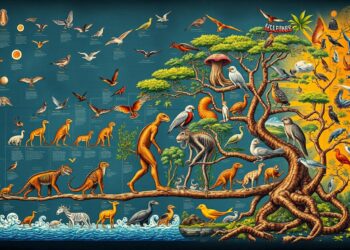
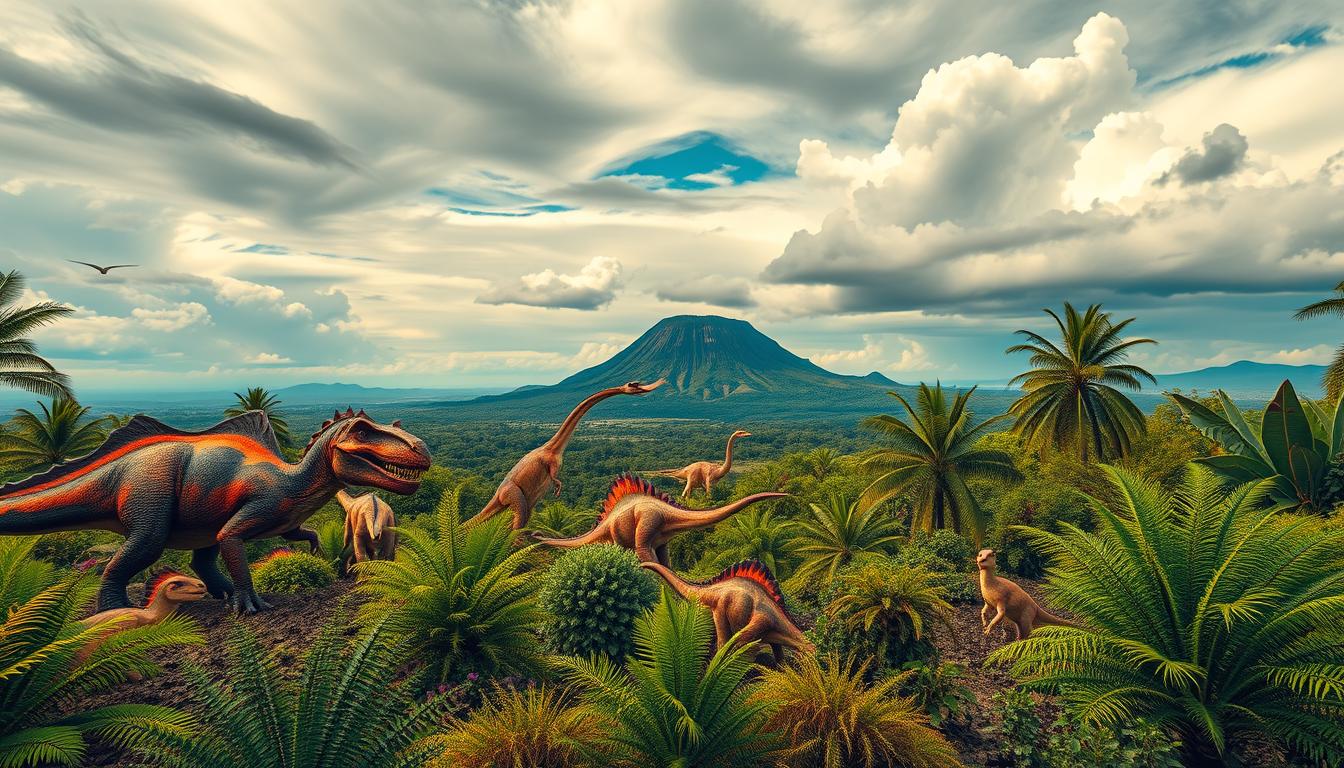
Paleontology is the study of ancient life forms. It gives us a peek into the distant past. Scientists look at fossils to learn about plants, animals, and ecosystems that once existed. These fossils tell us about the evolution of life and the big changes over millions of years.
Fossils are like time capsules. They show us the diversity and complexity of life long ago. From dinosaurs to ancient plants, these treasures help us understand the past. They reveal how environments, adaptations, and interactions shaped the natural world.
Paleontology combines biology, geology, chemistry, and more to study Earth’s history. By studying fossils, researchers learn about ancient life’s evolution, behaviors, and ecosystems. This way, we get a fuller picture of the past and unlock the secrets fossils hold.
Introduction to Paleontology
Paleontology is the study of ancient life and their fossils. It looks into Earth’s history, finding fossils of long-lost creatures. Paleontologists use many tools to learn about these ancient beings and their worlds.
The main goals of paleontology are to understand life’s evolution and past ecosystems. By studying the fossil record, they uncover the history of life. They show how diverse and adaptable prehistoric organisms were.
“Paleontology is a window into the past, allowing us to witness the remarkable journey of life on Earth.”
Paleontologists help us understand Earth’s geological history. They tell us about past climates and environments. Their work also helps us understand today and plan for tomorrow.
As paleontology grows, paleontologists use new methods like advanced imaging and genetic analysis. Their work brings us closer to the past. It inspires new scientists to explore our prehistoric world.
Major Fossil Types
Fossils are key to understanding ancient life. They range from giant dinosaur bones to tiny plant impressions. Scientists study three main types: body fossils, trace fossils, and microfossils.
Body fossils are the most famous. They include bones, shells, and even complete skeletons. For example, the Archaeopteryx shows how dinosaurs and birds are connected.
Trace fossils show what ancient creatures did. They include footprints, burrows, and even fossilized dung. These fossils tell us about the behaviors and interactions of ancient life.
Microfossils are tiny remains like pollen and single-celled creatures. They may seem small, but they tell us a lot about the past. Petrified wood is a great example, showing the details of ancient plants.
“Fossils are the preserved remains or traces of organisms that lived in the past. They provide a window into the history of life on Earth and offer clues about the evolution of species.”
By looking at all these fossil types, scientists can learn a lot. They help us see how life has changed over time. From the big T. rex to tiny microfossils, each fossil adds to our knowledge of ancient life.

The Process of Fossilization
Fossilization is a fascinating look into the ancient world. It shows us the details of life long ago. There are many ways organisms can be permineralized, or preserved as fossils, each unique.
Carbonization is a common method. It replaces organic matter with carbon, showing the organism’s shape. Molds and casts are also interesting. They happen when an organism decomposes, leaving a negative imprint that gets filled with sediment or minerals.
Amber preservation is perhaps the most captivating. It traps organisms in tree sap that hardens into a golden resin. This rare process lets us see ancient life in vivid detail, from insects to plants.
“Fossils are the remains of once-living organisms that have been preserved in the Earth’s crust. They provide a unique window into the history of life on our planet.”
Fossilization is a delicate process that needs specific conditions. Most organisms decompose and disappear. So, the fossilized remains we find are very valuable. By learning about fossilization, we can appreciate the rare insights these ancient artifacts give us into the past.
How Fossils are Discovered
The journey of finding prehistoric life starts with careful excavation of fossil sites. Paleontologists and amateur fossil hunters search the earth for clues. They look for signs of ancient life. This work requires patience, skill, and a sharp eye for detail.
The Burgess Shale in Canada is famous for its well-preserved Cambrian-era creatures. The La Brea Tar Pits in Los Angeles have given us Ice Age fossils like mammoths and saber-toothed cats. These fossil sites are key places for paleontological fieldwork, drawing scientists and fans from everywhere.
“The thrill of discovery is what drives us forward. Each new excavation has the potential to reveal something truly extraordinary about our past.”
Amateur fossil hunters also play a big role in paleontology. Their sharp eyes and hard work have found many new species. The careful fossil preparation and preservation of these finds let us study and enjoy them for years to come.

Finding fossils is an ongoing adventure. Each new excavation and fossil site could change how we see the past. Thanks to paleontologists and amateur fossil hunters, we keep learning about prehistoric life, one fossil at a time.
Understanding the Geological Time Scale
The story of life on Earth is etched in the rocks, as fossils. Paleontologists study these fossils to understand our planet’s history. They divide it into four main eras: Precambrian, Paleozoic, Mesozoic, and Cenozoic. Each era has periods, epochs, and ages, making a detailed timeline.
Paleontologists use radiometric dating to figure out fossil ages. This method tracks the decay of radioactive isotopes in rocks. It helps scientists date fossils accurately. This way, they learn about important events like the Cambrian Explosion and the dinosaurs’ extinction.
“The geological time scale is not just a dry academic exercise, but a window into the past that reveals the remarkable story of our planet’s evolution and the ancient creatures that once roamed the Earth.”
Knowing the geological time scale helps us understand the fossil record. It shows the long history of life on Earth. By exploring this story, we appreciate life’s strength and the changes that have shaped our world.
Discoveries of Iconic Dinosaurs
The world of paleontology is fascinated by the discovery of iconic dinosaur fossils. Creatures like the Stegosaurus and Triceratops have amazed scientists and the public. These ancient beings have captured our imagination.
“Sue,” the largest and most complete Tyrannosaurus rex, was found in South Dakota’s badlands. This paleontological expedition uncovered Sue’s nearly intact skeleton. It has given us valuable insights into this fearsome predator’s biology and behavior.
“Sue’s discovery was a game-changer, allowing us to study T. rex in unprecedented detail and challenge long-held assumptions about its life and role in the prehistoric ecosystem.”
The first Velociraptor fossils were found in Mongolia in the 1920s. They have changed how we see these smart, fast carnivores. Ongoing research is still revealing their hunting tactics and social behaviors, exciting both scientists and the public.

The Stegosaurus fossil was discovered in the late 19th century. This armored herbivore’s unique plates and spikes have become a symbol of the Jurassic period. They have inspired many books, movies, and museum displays.
As we keep finding more of these ancient giants, the field of paleontological expeditions is always exciting. It’s a constantly evolving area, giving us new insights into the lost world of dinosaurs.
The Role of Fossils in Evolution
Fossils are key to understanding life’s history on Earth. They show how species evolved over millions of years through natural selection. Transitional fossils, like Tiktaalik and Archaeopteryx, prove how species adapted to new environments.
Paleontologists study fossils to build phylogenetic trees. These trees show how different organisms are related. By looking at fossils’ features and when they lived, scientists can see how life branched out over time.
“Fossils provide a tangible record of how life on Earth has changed over time, allowing us to witness the remarkable adaptations and transformations that have shaped the diverse array of species we see today.”
Looking at transitional fossils is very important. They have features from both their ancestors and descendants. This shows how natural selection led to new species and changes in old ones.
Fossils, along with genetics and molecular biology, help us understand life’s history. By studying these ancient remains, we learn about evolution and how life adapts to change.
Fossils and Ancient Ecosystems
Fossils give us a peek into the past, showing us ancient ecosystems and climate changes. Scientists study paleoecology to learn about the past. They look at how different species lived together in old environments.
Looking at fossil assemblages helps a lot. These are groups of species found together. They tell us about ancient communities and their environments. Certain species, very sensitive to their surroundings, help us see past climate change.

Fossils are key to understanding mass extinctions. These big events changed life on Earth a lot. By studying fossils, scientists find out what caused these events. This helps us learn from the past and tackle today’s environmental issues.
“Fossils are the window to the past, revealing the secrets of ancient ecosystems and the forces that have shaped our world.”
Studying fossils helps us appreciate our planet’s history. It shows us how complex and changing our world has been. By learning from the past, we can better face today’s and tomorrow’s challenges.
Preservation Challenges
Keeping fossils safe is a tough job that needs careful attention. Taphonomy, the study of how fossils change, is key to solving these problems. It helps paleontologists and museum workers understand the hurdles they face.
Fossils are very delicate. Weather like temperature changes, humidity, and chemical reactions can harm them. Also, not handling them right can cause them to deteriorate slowly.
But, thanks to new methods, we can now protect fossils better. Museums use special storage, like controlled climates and safe packaging. Experts also use X-rays and CT scans to look inside fossils without damaging them.
“Preserving fossils is not just about protecting the physical remains, but also about unlocking the stories they hold – the tales of ancient life, evolution, and the shaping of our world.”
Studies in taphonomy have given us important knowledge. They help us understand how fossils are formed and preserved. This knowledge lets us learn more about the past and the history of life on Earth.
The Future of Paleontological Research
The field of paleontology is growing fast, thanks to new technologies. CT scanning lets scientists make detailed, 3D models of fossils without harming them. This method is key in studying ancient DNA, giving us clues about extinct species’ genes.
3D modeling is another big tool for paleontologists. It helps them study fossils in new ways, revealing how ancient creatures lived and adapted. This tech has led to major finds in molecular paleontology, where scientists study the chemical signs left in fossils.
“The future of paleontology is bright, as we continue to push the boundaries of what’s possible with advanced imaging and analytical techniques. The more we learn about the past, the better we can understand the present and prepare for the future.”
New methods are making paleontologists eager to find new species and solve old mysteries. They’re excited to learn more about Earth’s history and how life evolved. The future looks bright, with discoveries that will amaze both scientists and the public.
Conclusion: Why Fossils Matter
Fossils are key to understanding Earth’s past. They let us see how life evolved over millions of years. From dinosaurs to tiny organisms, fossils connect us to life’s story.
Fossils also capture our imagination and spark curiosity. They make science exciting for everyone. It’s important to keep these treasures safe for future generations.
Studying fossils helps us learn about our planet’s history. By supporting research and conservation, we protect our scientific and cultural heritage. Fossils show us the amazing diversity of life on Earth.