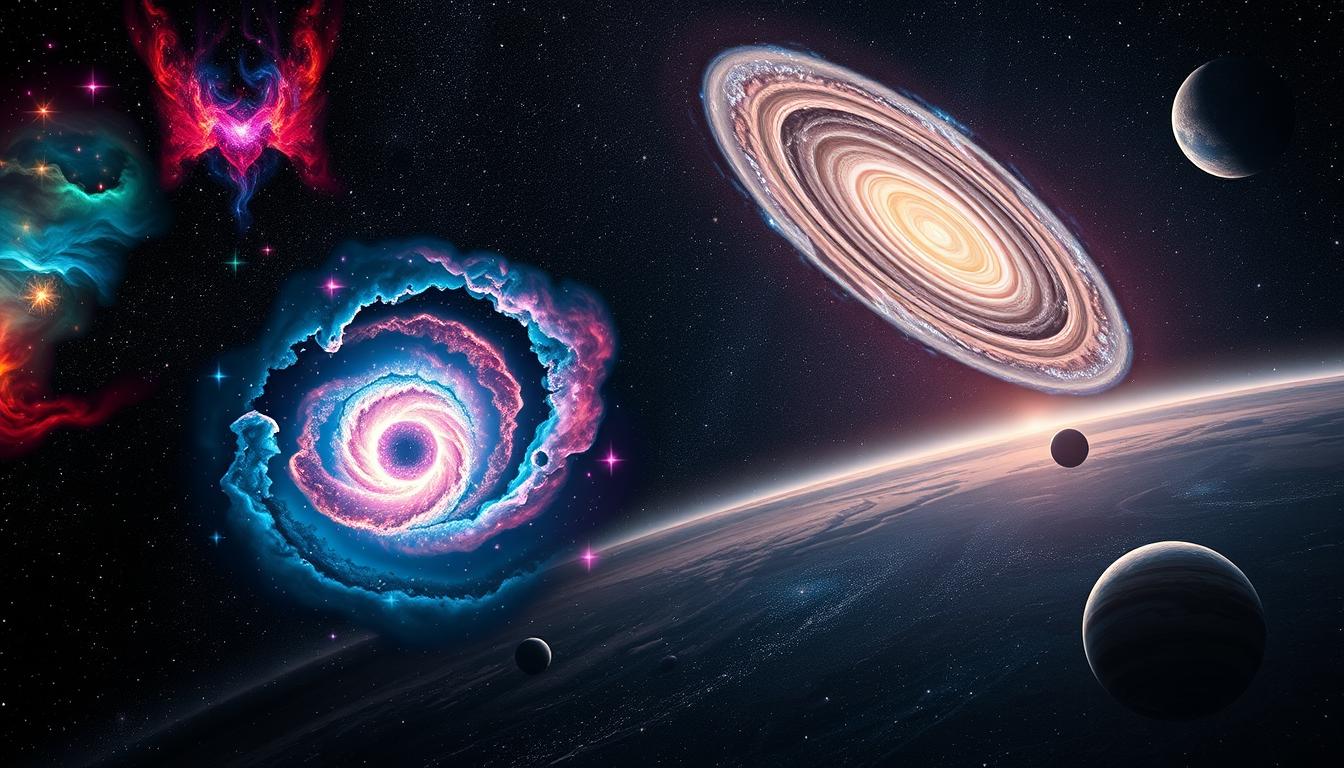
The universe is full of wonder, captivating our minds with its mysteries. Stars twinkle in the night sky, planets orbit our sun, and galaxies swirl around us. These celestial wonders have always inspired awe and curiosity in people.
Astronomy helps us understand these bodies and the forces that shape them. It has led to many scientific discoveries. These discoveries help us learn more about the universe and our place in it.
Looking up at the stars, we enter a world of endless possibilities. The laws of physics govern the birth, life, and death of stars. The life cycle of stars helps us understand our own existence.
Planets also fascinate us with their variety. Some are rocky and barren, while others are gas giants. Each planet shows the universe’s incredible adaptability.
Galaxies beyond our solar system invite us to explore the cosmos. Billions of stars in galaxies create intricate patterns. Each star could be home to undiscovered worlds.
Studying galaxies has led to major discoveries. We’ve found dark matter, dark energy, and supermassive black holes. As we explore more, our fascination with the universe grows. It fuels our desire to learn and uncover its secrets.
The Enigma of Stars
The universe is a captivating tapestry, woven with the intricate stories of stellar evolution. Stars are born, live, and die, each telling a unique story. These celestial bodies are key to understanding our cosmos. We explore their life cycles, revealing the wonders of supernovae and the mysteries of neutron stars.
Stars have a remarkable journey. They start from vast clouds of gas and dust. As they grow, some become red giants, while others shine brightly. When a star dies, it can explode in a supernova, leaving behind a dense neutron star.
“The stars are the apples of heaven’s orchard.” – Mike Dolan
Stars are not just beautiful to watch; they shape our universe. By studying stellar evolution, scientists learn about galaxy formation and heavy element creation. Each star adds to the universe’s story, inviting us to explore further.

The Wonders of Planets
Our solar system is a mesmerizing tapestry of celestial bodies. It’s full of wonders to explore. From the terrestrial planets – Mercury, Venus, Earth, and Mars – to the captivating gas giants – Jupiter, Saturn, Uranus, and Neptune – each planet has its own story.
The search for exoplanets, planets orbiting distant stars, has captured the scientific community’s attention. These alien worlds show us the diversity of planetary formation. They also hint at the possibility of life beyond Earth. Thanks to new technology, we’ve found many exoplanets, each with its own unique features.
“The universe is full of magical things, patiently waiting for our wits to grow sharper.” – Eden Phillpotts
The gas giants with their swirling storms and massive moons, like Jupiter’s Galilean satellites, amaze astronomers. The terrestrial planets – rocky, smaller, and closer to the Sun – have their own secrets. From Venus’s scorching heat to Mars’s polar ice caps, they are full of mysteries.

The search for habitable worlds beyond Earth is a thrilling quest. The discovery of exoplanets has sparked our imagination. It makes us wonder about extraterrestrial life and the conditions that might support it. The wonders of planets, both in our solar system and beyond, inspire us to explore the cosmos.
Understanding Galaxies
Galaxies are huge cosmic structures found in the Milky Way and Andromeda, among others. They are made up of stars, gas, and dust. Each galaxy has its own special features and history.
The Milky Way is a spiral-shaped galaxy with over 200 billion stars. It has a supermassive black hole at its center. Nearby, Andromeda is similar but offers a different view of the universe. Other galaxies, like elliptical and irregular ones, add to the universe’s beauty.
“Galaxies are the islands of the universe. They are the end products of cosmic evolution, the machinery that turns the basic ingredients of the universe into stars, planetary systems, and, ultimately, living beings.”
– Neil deGrasse Tyson
Studying galaxies helps us understand the universe. Astronomers look at dark matter to learn more about galaxies. By studying galaxies, we can see how the universe has changed over time.
Galaxies, from the Milky Way to Andromeda, fascinate scientists and the public. They give us a glimpse into the universe’s vastness and the forces that shape it.
The Scale of the Universe
Explore the vastness of the cosmos and discover its incredible scales. We’ll look at cosmic distances in light-years and the huge scope of the observable universe. You’ll see just how big the universe is around us.
Imagine the cosmic web, a huge network of galaxies, stars, and dark matter. It stretches across vast emptiness. This complex structure shows the universe’s enormous size. Trying to understand these huge scales can be hard for us, but it’s important for solving the universe’s secrets.

“The cosmos is within us. We are made of star-stuff. We are a way for the universe to know itself.”
– Carl Sagan, renowned astronomer and science communicator.
Learning about the universe’s scale fills us with awe and makes us humble. It reminds us of our small place in the universe. Let’s start this journey to understand the vastness that surrounds us.
The Science of Black Holes
Explore the fascinating world of black holes, where space and time warp around them. These cosmic mysteries have intrigued scientists and space fans for years. They are formed in mysterious ways and have a huge impact on the universe.
At the center of a black hole is the event horizon. It’s a point where nothing, not even light, can escape the black hole’s pull. As you learn more, you’ll discover the concept of singularity. It’s a point where physics stops making sense, and our understanding of the universe hits a wall.
“Black holes are where God divided by zero.” – Stephen Hawking
New discoveries in Hawking radiation have changed how we see black holes. They challenge our old ideas about matter and energy in extreme places. Scientists keep exploring, and black holes keep holding secrets waiting to be found.

Black holes affect everything from star formation to galaxy growth. Let’s dive into the science behind these massive objects. We’ll uncover the secrets that lie at the heart of our universe.
The Role of Telescopes in Astronomy
Telescopes have been key in understanding our universe. They help us learn about stars, planets, and galaxies. From the famous Hubble space telescope to the powerful radio telescopes, they have greatly expanded our knowledge.
Space telescopes, like Hubble, have changed how we see the universe. They can take clear pictures of distant objects because they are above Earth’s atmosphere. Radio telescopes, like ALMA, can detect faint signals from galaxies and gas in space.
New technologies like adaptive optics and interferometry have improved our views. Adaptive optics fixes the blurring caused by the atmosphere. Interferometry combines signals from many telescopes, making them work together like one huge telescope.
“Telescopes are the unsung heroes of astronomy, opening our eyes to the wonders of the cosmos and revealing the hidden secrets of the universe.”
Telescopes are still essential for exploring the universe. They help us study black holes and the structure of our galaxy. These tools have greatly changed how we see the universe and our place in it.
The Impact of Astronomy on Culture
Astronomy has deeply influenced human culture for centuries. It has inspired art, literature, and our understanding of ourselves. From ancient observatories to the space race, astronomy has left a lasting mark.
In ancient times, cultures built observatories to study the stars and planets. Places like Stonehenge in England and Chichen Itza in Mexico were marvels. They were also deeply spiritual and cultural. The heavens’ patterns and cycles shaped their myths and religions.
The space race in the 1950s and 60s was a turning point. It sparked a wave of sci-fi inspiration and deepened our interest in the cosmos. Iconic images and stories from the space race have shaped our culture and imagination.
“The cosmos is within us. We are made of star-stuff. We are a way for the universe to know itself.”
– Carl Sagan, renowned astronomer and science communicator
Today, astronomy’s influence is still strong. Ancient observatories attract tourists, and space race stories captivate audiences. Our fascination with the universe continues to grow, inspiring new generations to explore the cosmos.
Interesting Astronomy Facts for Everyone
Get ready to be amazed by the wonders of space! Astronomy is full of fascinating facts that excite space lovers of all ages. From tiny particles to huge cosmic events, the universe is full of amazing discoveries.
Did you know the Sun is 93 million miles away from Earth? Yet, its gravity keeps our planet in orbit. Or that a single teaspoon of neutron star material would weigh over a billion tons on Earth? These are just a few of the space trivia and astronomical discoveries that make astronomy so fascinating.
“The cosmos is within us. We are made of star-stuff. We are a way for the universe to know itself.” – Carl Sagan
From black holes to distant galaxies, there’s always something new to learn. Fun facts about astronomy can spark wonder and inspire us to explore the universe more.
Whether you love stargazing or just want to learn about the world beyond Earth, these interesting astronomy facts will captivate and enlighten you. Dive into the wonders of the universe and unlock the secrets of our cosmic home.
The Future of Astronomy
The future of astronomy is full of promise. We’re always exploring new things in science. Upcoming space missions and new telescopes will change how we see the universe.
Interstellar travel is getting closer to reality. New ways to move through space are being developed. This could let us explore other stars and maybe even find life beyond Earth.
New telescopes will give us amazing views of the universe. They’ll help us learn about stars, planets, and galaxies. We’ll also learn more about black holes and dark matter. The search for life in space is getting more exciting by the day.