The quest for life beyond Earth has fascinated us for ages. Thanks to space exploration and astrobiology, we now know more about life in the universe. We’ve found exoplanets and are searching for signs of life.
Astrobiology is a key field that studies life in the universe. It helps us understand where life can exist and how it might start. By exploring space, we’re getting closer to finding alien life or even simple microbes.
In this article, we’ll look at what we know about searching for alien life. We’ll cover astrobiology’s history, the latest missions, and the chances of finding life elsewhere. We’ll also talk about the ethics and culture of this groundbreaking research.
Introduction to Astrobiology
Astrobiology is a science that mixes biology, astronomy, geology, and chemistry. It studies life’s start, growth, and spread across the universe. This field tries to figure out where life comes from, if other places can support life, and if we can find life elsewhere, including extremophiles.
At its core, astrobiology seeks to know what makes life start and grow. By looking at Earth’s life origins, scientists hope to find universal life rules. They also want to see if life can exist on other planets or moons like Europa and Enceladus.
“Astrobiology is the study of the origin, evolution, distribution, and future of life in the universe.”
Recently, astrobiology has grown a lot. New tech lets scientists check out life-friendly places and extremophiles beyond Earth. By learning Earth’s life limits, scientists can spot life signs on other planets.
Overall, astrobiology changes how we see the universe and our role in it. As we explore more, astrobiology’s findings will change our view of the cosmos and our search for life elsewhere.
A Brief History of Astrobiology
The study of astrobiology has roots in ancient times. Philosophers wondered if life existed beyond Earth. The idea of panspermia, or life spreading through space, was first discussed in ancient Greece.
But it wasn’t until the 20th century that astrobiology became a real science. This was thanks to key experiments and space missions.
In 1953, the Miller-Urey experiment showed how life’s building blocks could form. This was a big step in understanding life’s origins on Earth. It led to more research on how life might have started.
The Viking missions to Mars in the 1970s were a big deal. They didn’t find life, but they gave us a lot of information about Mars. This helped set the stage for more Mars research.
In 1996, the Martian meteorite ALH84001 was found. It sparked a big debate about life on Mars. Even though the evidence was later questioned, it showed how interested scientists are in finding life elsewhere.
“The universe is a pretty big place. If it’s just us, seems like an awful waste of space.”
– Carl Sagan
As technology got better, so did astrobiology. We now have better telescopes and space missions. These have helped us find planets that might support life. Today, astrobiology is a mix of many sciences working together to explore life in the universe.

The Origins of Life on Earth
Scientists have been trying to figure out how life started on Earth for centuries. The idea of the primordial soup is a big part of this mystery. It says that early Earth’s air and water were perfect for the first simple life forms.
This soup, full of organic stuff, is thought to have led to the RNA world. In this world, RNA was key in the start of life.
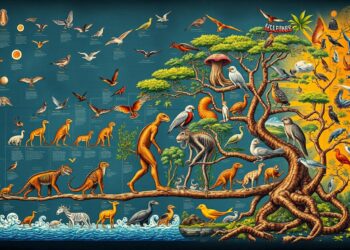
Looking for the last universal common ancestor (LUCA) is a major goal. LUCA is the ancient being that all life on Earth comes from. By studying old fossils and genes, scientists have learned a lot about how life evolved.
Old microbial fossils have given us clues about life’s early days. They help us understand how life began on Earth.
“The origins of life on Earth remain one of the greatest unsolved mysteries in science, but with each new discovery, we inch closer to unraveling this enigma.”
Learning about life’s start on Earth is not just cool science. It’s also key for finding life elsewhere. By studying how life began here, we can look for it elsewhere in the universe.
The Potential for Life Beyond Earth
The search for life beyond Earth has caught the eye of scientists and the public. Astrobiology focuses on finding life in our solar system and beyond. It looks for places where life could exist.
Habitable zones are key in this search. These are areas around stars where water can flow, a must for life. Moons of Jupiter and Saturn might have oceans under their icy surfaces. These could be homes for extremophiles, life forms that thrive in harsh conditions.
Mars is a big focus in the search for life. Missions have found signs that Mars might have had life before. Ancient rivers, minerals, and possible signs of life have sparked hope.

“The universe is a pretty big place. If it’s just us, seems like an awful waste of space.”
– Carl Sagan
Our understanding of the universe is growing. This makes the search for life beyond Earth even more exciting. With new missions and tech, finding life elsewhere is a top goal in astrobiology.
The Role of Exoplanets in Astrobiology
The search for life beyond Earth has led to a big focus on exoplanets. These are planets that orbit stars other than our Sun. The Kepler mission has greatly helped us learn about these planets.
Exoplanets have opened a new area in the search for life elsewhere. Scientists have found many types of exoplanets, including super-Earths. These super-Earths are bigger than Earth and might show us if other planets can support life.
Studying the atmospheres of exoplanets is key. Scientists look for gases like oxygen and methane that could mean life exists. This search has found some planets that might be able to support life.
As we learn more about exoplanets, they play a bigger role in astrobiology. What we learn from these planets will help us understand the universe and our place in it.
Searching for Extraterrestrial Intelligence (SETI)
The search for life beyond Earth has been a big part of radio astronomy. Scientists use powerful radio telescopes to look for signals from other civilizations. This effort, called SETI, has excited people all over the world.
The Breakthrough Listen project is a key part of SETI. It uses radio astronomy to search for signals that could come from aliens. The team uses the Drake Equation to guess how many civilizations might be out there.
“The search for extraterrestrial intelligence is one of the most exciting and important quests of our time. It has the potential to revolutionize our understanding of the universe and our place within it.”
Even though we haven’t found definitive proof yet, the search goes on. It’s making us learn more about the universe. The idea of finding intelligent life beyond Earth is thrilling to scientists and the public.

The Science of Biosignatures
In the search for life outside Earth, biosignatures are key. Biosignatures are signs of life on other planets or moons. They can be many things. Spectroscopy is a top method for finding them. It lets scientists study the gases in exoplanet atmospheres, like atmospheric methane or oxygen detection.
Methane is a gas made by living things. Its presence in a planet’s air might mean life is there. Oxygen, made by plants, could also hint at life on an exoplanet. These signs are what astrobiologists focus on, hoping to find life elsewhere.
“The search for biosignatures is a fundamental aspect of astrobiology, as it allows us to detect the chemical fingerprints of life on distant worlds.”
Another area of study is technosignatures. These are signs of advanced life, like artificial lights or signals. Finding technosignatures would be huge. But, they’re harder to spot than biosignatures, and scientists are still working on it.
As astrobiology grows, so does the study of biosignatures. By using spectroscopy and looking for different signs of life, scientists are learning more. They’re figuring out what life needs to exist on other planets.
Current Missions and Future Prospects
Exciting missions and space telescopes are leading us to new discoveries in astrobiology. The Mars 2020 rover is exploring the Jezero Crater on Mars. It’s looking for signs of life that existed long ago.
The Europa Clipper mission will soon launch to study Jupiter’s icy moon, Europa. It aims to find out if life exists in Europa’s ocean beneath the ice.
The James Webb Space Telescope is changing how we see the universe. It can see in infrared, helping us learn about distant planets. It might even find signs of life on other planets.
The TESS mission is scanning the sky for exoplanets. It finds thousands of planets that could have life. These planets might be studied further to see if they support life.
“These missions represent a new era of space exploration, one where the search for extraterrestrial life is at the forefront of our scientific endeavors.”
The future of astrobiology is looking very promising. With each new find and technology, we’re getting closer to finding life beyond Earth.
Astrobiology and Astrophysics
Astrobiology and astrophysics are closely linked. By studying stars and planets, astrobiologists learn about life beyond Earth. Stellar evolution helps us understand where life might exist. It shapes the zones around stars where life could thrive.
The study of planetary formation reveals many new planets. These planets might have what life needs. The idea of galactic habitable zones looks at the best places in the Milky Way for life. It considers things like the right elements and how much cosmic radiation there is.
Understanding cosmic evolution is key to knowing if life can exist elsewhere. By combining astrobiology and astrophysics, scientists get a clearer view of life in the universe.
“The search for life in the universe is one of the most profound and important quests of our time.”
Ethical Considerations in Astrobiology
As we search for life beyond Earth, astrobiology faces many ethical challenges. Planetary protection is crucial to avoid contaminating other planets with Earth life. We also worry about introducing alien life to our planet. The risks of contamination during space travel and first contact are carefully studied.
Creating first contact protocols is a complex task. It must balance our scientific curiosity with protecting humanity. Astrobiologists must think about the cultural and social impacts of finding intelligent alien life. They also consider how this would change our view of our place in the universe.
“The discovery of astrobioethics – the ethical considerations surrounding the search for and potential interaction with extraterrestrial life – has become a critical area of study in the field of astrobiology.”
Exploring the universe requires careful ethical consideration. We must act with respect for potential alien life and a deep sense of responsibility. Our actions should protect both humanity and our cosmic neighbors.

Public Interest and Cultural Impact
The search for life beyond Earth has captured the world’s attention. It goes beyond science, touching our culture deeply. Science communication helps make astrobiology easy for everyone to understand. Science fiction has also shaped how we see this field, making us wonder about the universe.
Projects like SETI@home have made people all over the world excited. They let millions help search for alien signals. This effort shows how eager we are to explore the cosmos together.
Astrobiology’s influence reaches far, even into tourism. Astrotourism lets people experience the universe up close. From stargazing trips to space-themed spots, it brings the cosmos to us.
“The search for extraterrestrial life has the potential to redefine our understanding of the universe and our place within it. As science communication continues to bridge the gap between the scientific community and the public, the cultural impact of this field will only continue to grow.”
As scientists learn more about astrobiology, our interest will keep growing. This will shape our culture and inspire new discoveries.
Conclusion: The Future of Astrobiology
Looking back, astrobiology has made huge strides. The future looks even brighter. With interdisciplinary collaboration, scientists, engineers, and explorers will uncover the universe’s secrets. They will also explore life beyond Earth.
Technological advancements are key to astrobiology’s future. New telescopes, space probes, and biosignature detection methods are being developed. These tools will help us explore the solar system, study exoplanets, and maybe find alien life.
Astrobiology is vital for space exploration and human expansion. It will help us understand which planets can support life. This knowledge will guide our journey to settle other planets and find new resources. Astrobiology’s discoveries will shape our exploration and settlement of space.